Saturday, February 28, 2009

God's Purpose

During my quiet times in the last 3-4 months, I've been looking at God's character and qualities that would help me get to know Him better rather than just understand Him more. While I seek the understanding, I really felt that the Holy Spirit was working in me to get to know Jesus better, and that comes by know the qualities of His character and how that is played out in my own life.

In reading half of Genesis [started with Jacob's fleeing from Esau] and starting in Exodus, the large portion of what I read so far is the life of Joseph and his brothers. And I kept asking myself, "What is it about God that is revealing to me?" Because in the story of Joseph, God's literal voice is absent - He doesn't actually say anything for chapters. But in the midst of Joseph's life, where his brothers' jealousy leads to their selling him, being in jail for 12 years, and reaching to the height of Pharaoh's kingdom only to be confronted by his family again, I wondered what qualities of God I was suppose to get.

As I thought more about it, the Holy Spirit led me to an important quality of God's. It is that God's purpose is perfect and bigger than anything we could have planned for. I think what I used to take away from Joseph's story is that if you are faithful in God during times of trials and act appropriately, God will make things better. And I still think there is a lot of truth in that. But this time around, I think I see that God has a purpose, and His purpose is only known to Him. And just as important, His purpose is redemptive. The story of Joseph is a redeeming one, where only God could know his purpose over a 12-20 year span. Despite Joseph's jealous brothers, God redeemed the story at the end with reconciliation and blessings.

God's purpose is bigger than us. It is bigger than the moment in which we live. I was talking to the wife and I don't think our purpose is to know fully God's purpose. That would, for all intents and purpose, make us God. God reveals His purpose to us when we need it and in the way we need it. But we always have to be ready and willing to submit to His plans. Because whatever season we are living right now, God's purpose is bigger than that - and if we don't believe that, then we're not seeing closely God's character. There is a story within each of us, and our stories are meant to be part of God's purpose, especially in its redemptive nature. God's redemptive purpose for Joseph was for him to be the head of Pharaoh's kingdom - but that couldn't have happened unless he was imprisoned and interpreted the dreams of Pharaoh's. Our stories are not unlike Joseph's. We too, have gone through ups and downs. But God's purpose is big. His purpose is perfect. And it is one of God's qualities that make Him uniquely God - that He is all knowing, and that His plans need no help from us from coming to fruition.

Sunday, February 15, 2009

What Kind of Justice Do We Seek?


A lot has been happening at work - none of which is pleasant. Layoffs, large debt, lowered revenues are all but larger clouds that form over our heads. Closer to the ground are decisions made by few that nonetheless leave us doubting right and wrong, justice and injustice.

I've already written about the Dilbert Principle, but beyond the concept of incompetent managers and executives that keep rising to the top like hot air balloons, I wonder: Where is the justice? Where is the right and wrong for those who are hard working and rewarded while those who sell their salesmanship are disposed? Part of the problem is that we all think, in varying degrees, we are hard working and our moral compass points to true north. And part of the problem with justice is we see it through the lens of our own corner, the corner we think has the best view of the room rather than through God's point of view, where what makes sense to Him, doesn't to us.

When I consider the fact that there are many executives out there who can't manage, lead, inspire, vision, develop, or coach, there are just as many arrogant, self-righteous, judgmental employees who think they can. And that's the rub. For all the incompetent managers and executives out there, there are equally the same number of self-righteous employees who feel they have been wronged by the Dilbert Principle. Justice outside of God's economy is a concept that doesn't reside in reality - at least not the reality that we want it to live in. Justice is only true in the people who talk about it like it's a bunch of "should's" situations that if only the people who make decisions can see, all would be "right" with the world. It "shouldn't" be this way, we tell ourselves. He/she "should" have been laid off, not him/her.

As I reflect on what is happening at my own job and company, I know the concept of justice is more than right and wrong. It is, without a doubt, a very dangerous and often disappointing view of a world that continues to shower CEOs and executives millions of dollars, only to see the companies they lead fail. For every good worker that stays, the same number of incompetent manager rises through the system that rewards the coterie of a few than the merit of the many. The world is not that simple, unfortunately. It's not just a matter of doing the "right" thing, but rather, it is a matter of living with integrity and with character that is often disappointing. But then again, who doesn't think they have integrity? Who doesn't think they have character? I guess that's why God is the judge and we "should" not be. Justice comes when we see decisions/acts that, to us, is so blatant that we await for the judge [whoever that is in the company] to right a "wrong". But it doesn't always happen. Why? I know it sounds so overused, but it's because life is very gray. Even if you remove one incompetent manager or executive, another will take their place to continue to run the show. So where is the justice? Is there no end to moronic decisions and idiotic leadership? As long as we [people] think we're running this life, justice is pushed through a vacuum that is random and unsettling. And even though I want the right things to be done and justice to prevail, that only happens in heaven and comic books. Life is full of oxymorons and contridictions. Unfairness and injustice is just part of a flawed system run by flawed people. And to push for justice that only God should be able to hammer down is an emotionally exhausting endeavor. The response is not to merely resign and give up, but it is to have community brought forth together to exhort, petition, pray, hope, and love - because God can only be the true Judge. When we try to be the judge and make sense of it all, we are left with being frustrated and in pain. We can only try to seek God and find peace that He has a purpose and His purpose is always perfect. It's easier said than done, but when it comes to corporate justice, there is little to be done with "should's" and more with just controlling the only thing we can: ourselves and the way we respond.

I'm not saying we should be in silence. I am not saying there's nothing we can do. We must speak up and act according to the injustice - but when we judge, when we hold the gavel, the world is no longer God's to own, but ours to ruin. We must stand up for the marginalized and those who have no voice. But to think that justice always prevail is also naive and innocent. Justice can only prevail when God is the judge. When we try to replace Him at the throne, we will be disappointed and more often than not, we will fail. I'm learning a big lesson for myself in all of this. I need to get off the throne so He can take His rightful place. Someone please tackle me out of the chair so God can sit where He needs to do His work. Because I'm tired and weary. Trying to make sense of it all is all too disappointing and painful. So it's time to let God finally do what only He can do - to perfect judge every situation in my life. To understand that His purpose is wholly good and true.

Monday, December 29, 2008

Cast Away


Cast Away was on TNT last night and I watched the last third of the movie. I was telling my wife that if that were to happen to me [stranded on a deserted island by myself], I would never last. Between the myriad of vermins and lack of anything civilized, I would probably last about a week. Tom Hanks' character, Chuck Nolan, lasted 4 years on this island. And as I watched this movie, I realize one of the themes is about loss and letting go.

During Chuck's four years on the island, he befriends a Wilson volleyball from one of the many FedEx packages that washes on shore after the plane crashes in the ocean. After getting cut from trying to start a fire, he picks up the ball and hurls it. He realizes the bloody handprint on the ball resembles a face. And from there, out of his loneliness, he starts to have a friendship with Wilson He converses, argues, and has a relationship with this inanimate object because he is desperate for relationship. The sense of time, which is so crucial to Chuck's life before as a FedEx employee, evaporates as he hsd nothing but time now. He has no choice but lose that part of his life and embrace surviving and holding on to the one thing that will keep his hopes alive: The thought of returning and being with his love, Kelly. After four years, Chuck builds a raft and leaves the island, finally feeling he has the courage and strength to try to get rescued. In his torturous journey with his raft in the middle of the Pacific, Wilson, falls from the post it is perched up on and drifts off into the horizon. Chuck desperately tries to "save him", but ultimately has to choose the raft over rescuing his friend. As he lies on his raft, he is sobbing, saying the name "Wilson", over and over again. Apologizing for not saving him. When he finally gets rescued, he finds Kelly married with a child. She tells him everyone told her he was dead and to let him go.

No one lives a life free of pain and loss. We have all lost - close relatives or friends, a favorite heirloom or item and it hurts, evenif we try to be self protective and not let down our guard. Chuck loses two relationships that were vital for his survival, Wilson and Kelly. Wilson is the relationship that keeps him sane through his loneliness and Kelly is the hope he needs to leave the island to try and go back to her. This movie reminded me we all need relationships and a hope to live. With all due respect to Paul Simon, no one is an island and the rock can feel pain. The pain that Chuck feels is one of loneliness and fear. He is both alone and lonely. The fear that he will die as such. But the hope that carries him off is Kelly. She is the hope he needs to get off the island. And when he returns, he has to lose her all over again because she had to move on.

The sense of loss is overwhelming, especially when we are in the midst of the pain. We are not in control. We want to relieve the pain as quickly as possible and we will do whatever it takes to take control of it again. In the moment of loss, I know that it is scary and it is painful, but I think that's what God wants me to see in this movie, that there is hope. But His hope is not going to disappoint me like Kelly disappointed Chuck. His hope is filled with goodness and strength, but it has to be on His terms. I choose hope out of despair, but I normally want it my way. Because it's convenient for me. Because I am in control. But in letting go of that control, God catches me and doesn't let go, even though it's scary. If I can get off the throne and let Him be the King as is rightly His to take, I can finally invite Jesus to relieve the pain that only He can relieve. In letting go, I am submitting my own disturbed way of living to something better, to a hope that never fades. At the end of Cast Away, Chuck finds freedom in delivering the only FedEx package he did not open. And finally, he is able to let go of Kelly and sees life as opportunistic again. And that's the hope that I want to find in Jesus, who never fails and who never lets go. But I have to learn to do that in His timing and give up control - submitting to His plans and His ways. It is so difficult, because fear is a great de-motivator. But God is about hope and life and freedom. And even in a movie like Cast Away, I can learn to see the possibility of letting go and embracing a sense of loss. The loss of relationships. The loss of kingship. Submitting to a new King and living a life of freedom and grace.

Monday, November 24, 2008

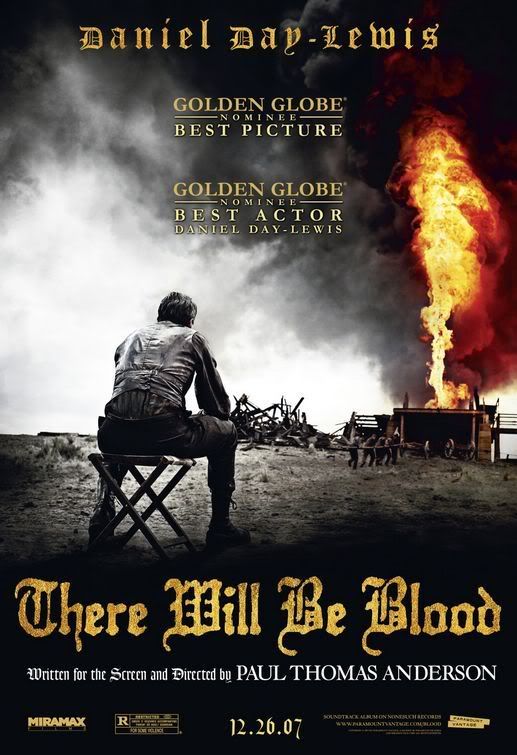
There Will Be Blood


We watched the movie "There Will Be Blood" this weekend. I watched to see Daniel Day Lewis' Oscar performance and I have to say, I'm confused. I thought the acting was tremendous. Daniel Day Lewis fully immersed himself to be a man whose character, Daniel Plainview, is anything but in plain view.

The story is simple enough. Plainview is an oil man who leases land in California to drill and ends up in an agreement with Union Oil to build an oil line to the Pacific Ocean. But in the middle, I was caught up with Plainview's character. A man who seeming is driven by greed and shuns people as a way to be isolated from love and community. We never see Plainview speak of love or women, just associates who come in and out of his life. The one person he does love is his son, H.W., who he adopts after one of his workers die in a drilling accident. But after a freak accident in which H.W. loses his hearing, Plainview cannot reconcile the love he has for his little boy to a frustrating and often hurting soul that cannot heal his impairment. His nemesis in the movie are not other business associates, but a young man who claims to be a church healer, a person whose hubris in being the minister of the church leads him and Plainview to be at odds over who runs the town. Is it the healer, who's congregation is blinded by his over zealous messages of faith healing, who the people turn to? Or is it the oil man who is giving them money as he makes millions off as he dries up their fields of natural resources?

I can't decide if I really like this movie or if I just like it. The story ends abruptly [I won't give it away here] and we were left with going to the computer to see what it was about. I told the wife the part of me that's having a hard time reconciling with this movie is the idea of redemption is missing for me. Normally, a story has a character who goes through a redemptive process that makes us want to relate to him/her. Here, I just couldn't relate to Plainview. Or, I didn't want to.

For those who've seen it, give me your thoughts. It'll help me sort through some questions I have about the movie.

Friday, November 7, 2008

Valjean


I have been thinking about identity recently.  I know history tells us names of individuals has significance, like when my wife reminded me that Leah named her first born with Jacob as Ruben, meaning he has seen my misery.  A testament to her status as Jacob's less favored wife. The identity that God reveals to Moses as Yahweh, or I Am.   He revealed Himself and dwelt in the temple Solomon built in 2 Chronicles.  

This idea of identity was enforced when I recently listened to the music from Les Miserable'.  The protagonist, Jean Valjean, goes through different identities in the story to stave off Javert, the self-righteous police inspector who will do anything to catch Valjean.  The beginning of the musical has a very intense and strong interaction between Valjean and Javert.  Valjean had been imprisoned in jail because he stole a loaf of bread from a baker so his sister and her child wouldn't starve to death.  He was then imprisoned for another 14 years because he tried to escape.  In the prison, he was merely known by a number, prisoner 24601.  For 19 years, that was his identity.  And when he was finally up for parole, Javert calls him by his prison identity:

[Javert]
Five years for what you did
The rest because you tried to run
Yes, 24601

[Valjean]
My name is Jean Valjean

[Javert]
And I'm Javert
Do not forget my name!
Do not forget me, 24601

The insistence on calling Valjean 24601 is something that clearly offends Valjean.  He has a name.  And his name is not 24601.  The identity that we all find in our names becomes a birth right.  We feel entitled to be called by our given name.  When someone mispronounces my name, I feel compelled to correct them, to make sure they know when they talk to me, the correct identity is addressed.  

So when I think about my identity in Christ, it's tough to see what that looks like.  It's difficult to know what my identity is in Jesus.  Don't I have my own identity?  Wouldn't Jesus want me to have my own identity, separate from Tom, Dick, and Harry?  The answers seem academic.  "Well, we are to live our lives for Christ and thus, we place His identity as our own."  But soon I realize that that's not what I am confused about nor am I questioning.  What has made me think so deeply about identity is that God created me to be who I am.  And He accepts and loves me for who I am.  And who I am is different than anyone else, so what is this identity?  I can't say I have truly heard God say, "Your identity is..."  The wife and I had a good conversation last night about purpose.  The purpose God gave each of us.  What is my purpose?  Or more deeply, what is my identity?

In the story, Valjean becomes a respectable citizen after he leaves prison, and takes on another identity, that of Father Mandeleine.  When Javert senses that Father Mandeleine is actually Valjean, he moves in to arrest him, but the police tells Javert they have found the real Valjean [in actuality, it's another person they think is Valjean].  What will Valjean do?  Will he allow an innocent man to be condemned or will he face the truth and reveal himself to be the real Valjean?

[Valjean]
Who am I?
Can I condemn this man to slavery?
Pretend I do not see his agony?
This innocent who bears my face
Who goes to judgment in my place
Who am I?

Can I conceal myself forevermore?
Pretend I'm not the man I was before?
And must my name until I die
Be no more than an alibi
Who am I?

How can I face my fellowmen?
How can I face myself again?
My soul belongs to God, I know
I made that bargain long ago
He gave me hope when hope was gone
He gave me strength to journey on

Who am I?  Who am I?
I'm Jean Valjean

And so Javert you see it's true
This man bears no more guilt than you
Who am I?
24601!

Valjean does the right thing by handing himself over to Javert.  His identity isn't, truly, 24601, but it's Jean Valjean, the man who's "soul belongs to God".  The identity is not Father Mandeleine.  It's not even 24601.  But it's the man who's identity God created.  A man of justice.  A man of truth.

To align with God's identity for me is a difficult journey.  There are seasons in my life where I am Father Mandeleine, the citizen of the year award who takes in prostitutes like Fantine and cares for her daughter Cossett.  The are seasons when I'm the law breaker, the one who justifies stealing a loaf of bread to feed the hungry.  But God's identity for me does not change.  It is the same yesterday, as it is today, as it will be tomorrow.  I can try to be different people - people whose identity I feel I need to be.  But God's identity for me is not Father Mandeleine or 24601.  It's an identity that is true to my soul.  Party of this identity is to be worshipful.  To worship the one who has not creator.  To worship the one who desires and deserves my worship.  That alone invades the inner core being - to worship Him with an integrated life of work and personal lives.  There is no recipe, there is not thunderous voice from heaven.  But there is the Holy Spirit who intervenes and intercedes for me and I do it in my gut.  But another question arises.  Am I willing to be who God created me?  Or am I too comfortable being another person?  It is a good question.  Who am I?  Who am I?  This journey continues with questions and seemingly few answers.  But I belief the Holy Spirit is at work and it will help with that burning flame in my stomach to come alive at the right time.

Sunday, October 26, 2008

Who's the King?


Today's message at Rock Harbor was one of the best on worship.  It affirmed what I've learned [academically], but it also spoke to my heart.  Over the last year, I've been torn down over and over again by God on worship.  What was my theology on it and how do I practice it?  It's safe to say that before I went down this journey, I always viewed worship as a secondary thought to theological heavy weights such as love, advocacy, relational wholeness, and service.  The Holy Spirit has really guided me to believe and understand that these issues are are not separate from worshiping Him.

The whole idea of worship sounds all too familiar - some Matt Redman and Tim Hughes songs before and after service and voila!  Worship set.  Throw in a good prayer here and there and it's good bread that surrounds the meat [message] of Sunday service.  And with lo-carb diets in fad, worship is really just fluff, unneeded in the world of the theologically sound.  That's obviously an extreme and not too many followers truly believe that, but there is some truth to that view.  But God is looking for worshipers:

Woman, believe me, the hour is coming when you will worship your Father neither on this mountain nor in Jerusalem.  You worship what you do not know; we worship what we know, for salvation is from the Jews.  But the hour is coming, and is now here, when the true worshipers will worship the Father in spirit and truth, for the Father seeks such as these to worship Him.  God is spirit, and those who worship Him must worship in spirit and truth.  John 4:21-24

This passage blew any preconceived notion for me on worship.  It had a context now.  God seeks worshipers who will worship Him in spirit and truth.  Todd Proctor, lead pastor at RH, gave a great example today of worship.  He likened it to a U2 concert, where people are there waiting in anticipation of the group.  And when they come on stage, the arena is electric.  Fans go wild and figuratively, they begin their worship.  The band hasn't played a note.  Bono has not sung a word.  And yet, U2's presence is felt.  So large that people scream and yell.  Isn't it sad then, that many today go to worship service with the attitude of "prove it to me again God?"  Or, put the mood music on so I can really worship.  God is not seeking those kinds of worshipers.  The anticipation to come before God, to feel His presence, doesn't make us scream or shout.  It makes us come and want to dump our problems on to Him.  And although He is the healer and He wants that from us, we have placed worship for people like Bono, because let's face it, Bono is really cool.  Bono challenges the way we live.  And Bono is, well, Bono.

So the question bares itself in who we prostrate ourselves in worship to?  Many times, the King who is expectant of our worship receives our troubles, our self doubts, and our wants and desires.  That's all good, but then, He is no longer our King.  The King is inevitably, ourselves.  It is what is going on for us that matters.  It is what we need that matters.  It is no longer about God and the mere presence of Him that makes us fall face down in wonder and awe.  His presence only gives us permission to tell Him how important we are.  It's tough for us to look beyond ourselves because the enemy has made it hard to focus on anything else.  The fall of Adam was all about us [as people] and how we can be God.

God not only deserves our worship, He seeks it.  He doesn't need it as He so poignantly describes in Isaiah 50.  He doesn't need our worship, but He delights in it.  He was meant to be Israel's one and only King, but we rejected that idea.  We saw other nations having Kings and we felt that for us to be a nation, we too had to have a monarch rule over us.  Revelations gave us an idea of what worship ought to be like:

Day and night, they never stop saying: "Holy, holy, holy is the Lord Almighty, who was, and is, and is to come."  Whenever the living creatures give glory, honor, and thanks to Him who sits on the throne and who lives for ever and ever, the twenty four elders fall down before him who sits on the throne, and worship him for ever, and ever.  They lay their crowns before the throne and say: "You are worthy, our Lord and God, to receive glory, honor and power, for you created all things, and by your will they were created and have their being."  Revelations 4:9-11

He is our King, who sits on the throne who is worshiped for ever, and ever.  He is worthy.  We must get off the throne and allow God to sit on the throne, His rightful place in our lives.

Saturday, October 25, 2008

Rock N Rolla


Rock N Rolla is one of those movies that will first make you say out loud, "What's going on?" to "Wait, I thought he was with them...oh, he wasn't with them, he was with them."  We liked the movie.  It was one of the better movies we've seen recently.  Of course, we had a couple of bad runs: Eagle Eye and Burn After Reading.  

Rock N Rolla has that caper kind of movie feel, but with some really good acting - especially by Tom Wilkinson.  And we thought it was a typical Guy Ritchie movie where the story is so broad in the beginning, you can't seem to find any connects.  Then as the story unfolds, you realize things start to all tie together.  The funniest scene - and I can't give it away - comes as the credits are rolling.  It's a scene between One Two [Gerard Butler] and Handsome Bob [Tom Hardy].  I knew my wife liked it because through most of the movie, she was engaged and had a smile on her face.

So go watch the movie!  It's a good one and I don't think you'll be disappointed.

Rock N Rolla Trailer here.